Losing Fat vs Losing Muscle: How to Tell Which One Is Leaving
The short answer
Your scale cannot tell the difference, but your body leaves clues: strength dropping in the gym, weight falling unusually fast, constant tiredness, and clothes loosening everywhere except the waist all point toward muscle going out the door with the fat.
The only way to actually know is to measure body composition, with periodic clinical scans or a weekly trend on a segmental smart scale. Everything else, including this article's checklist, is educated guessing.

The whole question in one image: the tape measures what leaves, the iron decides what stays.
Two people each lose ten pounds. The first loses nine of fat and one of muscle: leaner, stronger-looking, metabolism intact. The second loses six of fat and four of muscle: smaller, softer, and burning fewer calories at rest than before. Same scale victory, opposite outcomes. The frustrating part is that the bathroom scale reports both as identical success.
Why a pound is not a pound
Weight is a total. It counts fat, muscle, water, glycogen and this morning's breakfast with perfect indifference. During weight loss, the body draws on fat stores and lean tissue at the same time, and the ratio between them is the entire ballgame. Muscle burns more energy at rest than fat, holds you upright at seventy, and shapes the "after" photo. Lose too much of it and the diet quietly sabotages the very metabolism that has to maintain the result.
Three things push the ratio the wrong way: deficits that are too aggressive, protein intake that quietly collapses, and muscles that never get a reason to stay. Crash diets manage all three at once, which is why the pounds so often return, but the muscle does not.
Six warning signs the loss includes muscle
- Your lifts are shrinking. Some strength dip in a deficit is normal. A steady slide, week after week, is the loudest alarm the gym can give you.
- The scale is falling fast. Faster than roughly one percent of body weight per week, sustained, usually means the loss is not all fat. Fat has a burn rate; ultra-fast loss recruits other tissue.
- You are tired all the time. Persistent fatigue beyond ordinary diet grumpiness often tracks with underfueled muscle.
- Everything shrinks except the waist. Arms and legs thinning while the belly holds suggests lean tissue leaving the limbs.
- You look smaller but not leaner. The "deflated" look instead of the "defined" look is composition talking.
- Protein and lifting are both missing. Not a symptom, a forecast: if neither is in your week, the ratio is drifting wrong right now.
The only way to know for sure: measure composition
There are two practical options, and I have tested both approaches against each other in detail.
Periodic clinical scans. A DEXA scan ($40 to $150 per visit) is the reference standard and will tell you precisely how much lean mass you carried on scan day. Its weakness is the calendar: quarterly snapshots cannot warn you about this month's mistake.
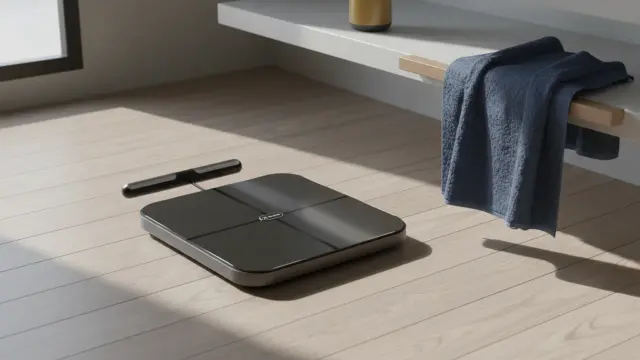
A weekly trend at home. A segmental body composition scale estimates fat and muscle separately, and while any single reading wobbles with hydration, the weekly trend under consistent conditions is reliable direction. This is exactly the "am I losing the right tissue" question, answered every Sunday. I documented eight weeks of doing this in my Hume Body Pod review, including the moment the trend showed my weight barely moving while fat fell and muscle rose, the good version of the story the scale alone could never have told me. The full precision trade-off lives in Body Pod vs DEXA, and whether that is worth the money for you comes down to how often you will actually step on it.
The segmental scale from our 8-week test. Trends, not gospel; measured mornings, same conditions.
How to steer the loss toward fat
The basics are unglamorous and consistently supported. Specific numbers for your body belong with a professional; the directions are these:
- Moderate the deficit. The slower path keeps more muscle. If the scale is diving, you are not winning faster; you are losing different tissue.
- Protein at every meal, deliberately. The raw material for keeping muscle. This gets harder when appetite is low, which is why it needs to be planned rather than hoped for; readers on appetite-suppressing medications have it hardest of all, and I wrote about tracking muscle on GLP-1 separately.
- Lift something, two or three times a week. Resistance training is the signal that the muscle is still employed. Bands, dumbbells and bodyweight all count.
- Sleep like it matters, because the repair work happens there.
Frequently asked questions
How can I tell if I'm losing fat or muscle?
Clues: falling strength, very fast weight loss, constant fatigue, limbs shrinking while the waist holds. Certainty: only body composition measurement, clinical or at-home trends.
Why does the body burn muscle at all?
A deficit draws on all reserves. Big deficits, low protein and unused muscles shift the draw toward lean tissue. The body keeps what it is convinced it needs.
How do I lose fat without losing muscle?
Moderate deficit, protein at every meal, resistance training a few times weekly, real sleep. Boring, effective, and the ratio follows.
Can lost muscle come back?
Usually yes, with training and protein, and often faster than it was first built. But protecting beats rebuilding, every time.
Bottom line
Ten pounds down can be a triumph or a slow-motion mistake, and the bathroom scale genuinely cannot tell you which. The warning signs whisper; the composition trend says it plainly.
The happiest discovery of my own testing was learning I had spent six weeks believing a lie in the wrong direction: the scale called my progress mediocre while the composition data showed recomposition, fat down and muscle up. It cuts both ways. Whichever direction your scale is deceiving you, the fix is the same sixty seconds of measurement each morning, and the willingness to believe trends over feelings.
Keep reading
 Hume Body Pod Review: I Tracked My Body for 8 Weeks. Here's the Truth
 Losing Inches but Not Weight? Relax. It's Usually Working.
 How to Track Fat Loss Accurately (When Every Number Lies a Little)
- General exercise-science consensus on lean mass retention during caloric deficits (protein adequacy, resistance training, moderate deficit rates)
- Hands-on composition tracking methodology: our 8-week Hume Body Pod test and DEXA comparison
- Rate-of-loss guidance (~1% body weight/week) reflects commonly cited coaching ranges, not individual prescription.